


Lower back pain can make even simple activities uncomfortable. Sitting at a desk, driving, bending, standing for long periods or getting out of bed may become difficult when your back feels painful or stiff.
While some episodes of back pain improve with time, persistent discomfort can affect mobility, sleep and daily routines.
Kati Basti is a traditional Ayurvedic therapy involving the application of warm medicated oil to the lower-back region. It is used in Ayurvedic practice as part of individualized care for selected musculoskeletal concerns.
But what exactly happens during Kati Basti? Who may be suitable for it? And how is it different from a regular oil massage?
This article explains the traditional procedure, its intended benefits, important precautions and the role of doctor-guided Ayurvedic Treatment in Dubai.
What Is Kati Basti?
Kati Basti, also written as Kati Vasti or Kati Vasthi, is a localized Ayurvedic oil-retention therapy.
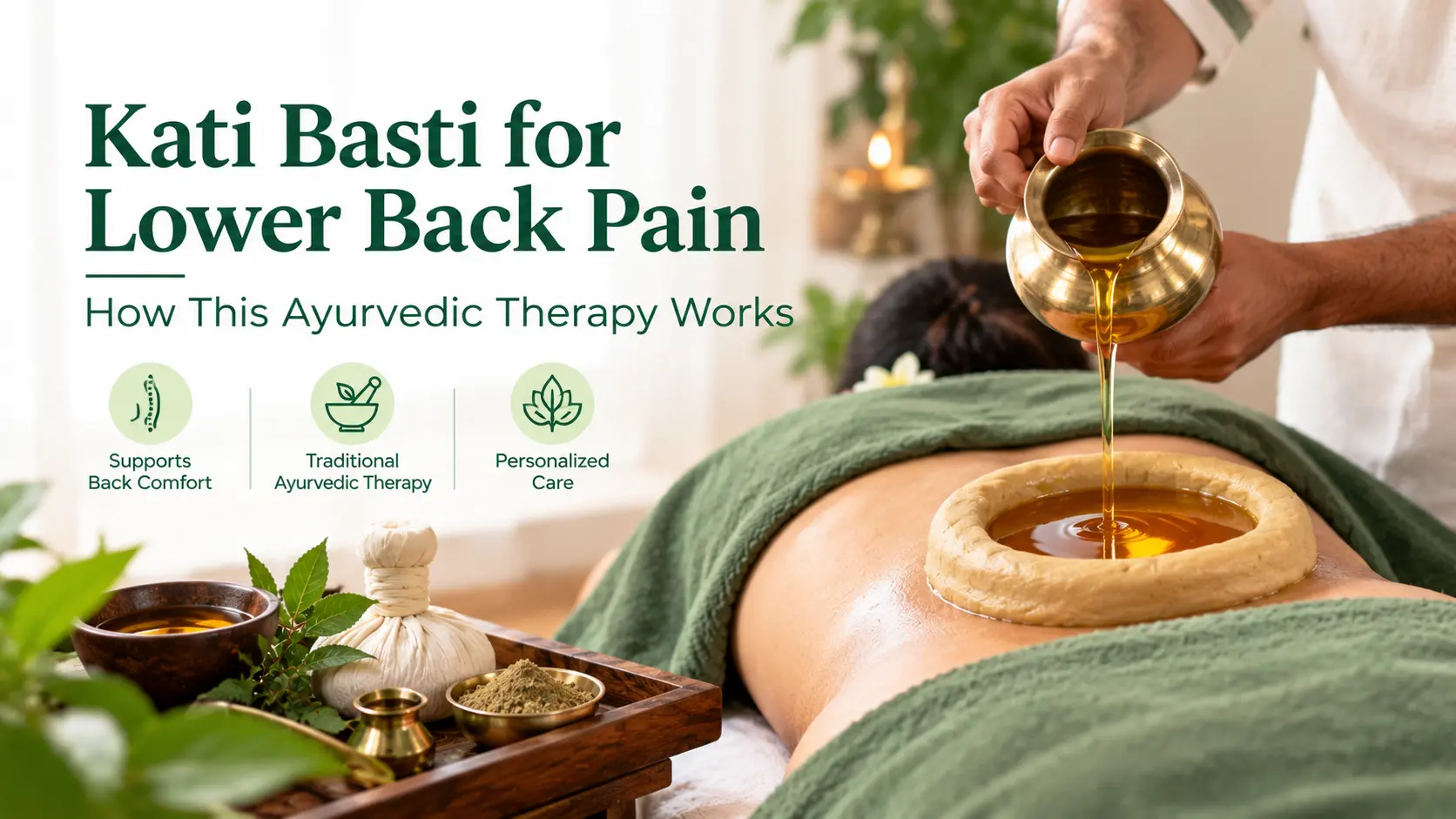
The word Kati refers to the lower-back region. During the procedure, a specially prepared ring, traditionally made using dough, is positioned over the lower back. Warm medicated oil is carefully retained inside this ring for a prescribed period.
Unlike a regular massage, where oil is applied and moved across the skin, Kati Basti allows warm oil to remain in contact with a specific area.
The therapy is traditionally associated with Vata-related musculoskeletal discomfort in Ayurveda.
However, the traditional explanation is not the same as a modern medical diagnosis, and there is limited high-quality clinical evidence establishing Kati Basti’s effectiveness for specific back conditions.
Why Does Lower Back Pain Occur?
Lower back pain can develop for different reasons. Some cases involve muscles and ligaments, while others may be associated with spinal structures or nerve-related conditions.
Common contributing factors include:
| Possible factor | How it may affect the lower back |
|---|---|
| Muscle strain | Overuse or sudden movement may cause pain and stiffness |
| Prolonged sitting | Extended periods in one position may contribute to discomfort |
| Disc-related problems | Spinal disc changes can sometimes irritate nearby nerves |
| Degenerative changes | Age-related changes may contribute to pain or reduced mobility |
| Physical inactivity | Reduced strength and conditioning may affect back function |
| Injury | Falls, lifting injuries or other trauma may cause back pain |
Not all lower back pain requires the same treatment.
For example, pain limited to the lower back may have a different cause from pain that travels into the buttock or leg.
If you experience radiating pain, tingling or numbness, our article Pain Shooting Down Your Leg: How to Recognise Sciatica and When to Seek Help explains the symptoms that may indicate nerve involvement.
How Is Kati Basti Performed?
Kati Basti is performed by a trained Ayurvedic therapist following a practitioner’s assessment and instructions.
The exact procedure may vary according to the person’s condition.
Step 1: Ayurvedic Consultation
Before recommending the therapy, the practitioner reviews the patient’s symptoms, health history, previous diagnoses and suitability for localized heat and oil application.
Step 2: Preparing the Lower Back
The patient is positioned comfortably, usually lying face down. The treatment area is prepared, and a ring made from suitable dough is positioned over the lower-back region.
Step 3: Applying Warm Medicated Oil
Practitioner-selected medicated oil is warmed to an appropriate temperature and carefully poured into the prepared ring.
The temperature must be monitored to prevent burns or discomfort.
Step 4: Retaining the Oil
The warm oil remains over the treatment area for the prescribed duration. The therapist may replace or adjust the oil to maintain a suitable temperature.
Step 5: Completing the Procedure
After the prescribed period, the oil and dough ring are removed. Gentle massage or other procedures may be included when appropriate.
The practitioner determines whether additional sessions or other supportive measures are suitable.
What Are the Traditional Benefits of Kati Basti?
In traditional Ayurvedic practice, Kati Basti is used with the intention of supporting comfort and mobility in the lower-back region.
Its traditional therapeutic goals include:
- Supporting relaxation around the lower back
- Addressing localized stiffness
- Providing warmth and comfort
- Supporting flexibility and comfortable movement
- Complementing an individualized Ayurvedic care plan
These are traditional intended benefits, not guaranteed treatment outcomes.
Although research suggests some complementary approaches may help certain types of lower back pain, findings for massage, yoga or other therapies should not automatically be applied to Kati Basti.
According to the National Centre for Complementary and Integrative Health, evidence and safety vary considerably between complementary approaches.
Kati Basti vs Regular Ayurvedic Oil Massage
Both therapies involve oil, but their methods are different.
| Kati Basti | Ayurvedic oil massage |
|---|---|
| Focuses on a localized area | May cover larger areas of the body |
| Warm oil is retained in a dough ring | Oil is applied using massage movements |
| Requires a specially prepared setup | Primarily involves manual techniques |
| Selected for specific therapeutic goals | May be used for broader relaxation and wellness |
| Duration and oil selection are individualized | Techniques and duration are also individualized |
Neither therapy should automatically be considered better. Suitability depends on the person’s condition and treatment goals.
Is Kati Basti Suitable for Everyone?
No. Kati Basti should not be selected without an appropriate assessment.
People with broken or infected skin, reduced temperature sensation, certain inflammatory skin conditions or other relevant health concerns may require the procedure to be avoided or modified.
The practitioner should also consider pregnancy, allergies, existing medical conditions and the possibility of nerve-related symptoms.
Because the procedure involves warm oil, careful temperature control and appropriate supervision are essential.
Kati Basti should not replace medical assessment or treatment for a suspected spinal injury, serious nerve compression or another condition requiring conventional medical care.
Can Kati Basti Be Used for Sciatica?
Kati Basti is sometimes included in traditional Ayurvedic care plans for people experiencing lower-back discomfort associated with sciatica.
However, sciatica involves irritation or compression of a nerve or nerve root, and its underlying cause must be considered.
A warm-oil procedure should not be assumed to correct a herniated disc, reverse nerve compression or treat every cause of radiating leg pain.
For people seeking information about individualized care, Dhanwanthari Ayurveda provides a dedicated page on Sciatica Ayurvedic Treatment in Dubai.
Treatment selection should follow a professional assessment, especially when pain is accompanied by numbness or weakness.
The Ayurvedic Perspective on Lower Back Health
Ayurveda traditionally associates certain patterns of pain, dryness, stiffness and restricted movement with Vata.
A practitioner may consider the person’s Prakriti, symptoms, lifestyle, digestion, daily routine and overall health when developing a treatment plan.
Depending on the assessment, the plan may involve localized therapies, other traditional treatments, dietary guidance and changes to daily habits.
The aim is to personalize care rather than recommend the same therapy for every patient experiencing back pain.
Dr. Jaisam’s Clinical Perspective on Musculoskeletal Care
Expert Contributor: Dr. Jaisam
Consulting Physician, Dhanwanthari Ayurveda, Dubai
Dr. Jaisam’s clinical areas include musculoskeletal concerns such as joint pain, lumbar discomfort and sciatica.
For patients considering traditional Ayurvedic therapies, understanding the location, duration and nature of pain is an important part of deciding what type of care may be appropriate.
A patient experiencing muscular stiffness may require a different assessment and care plan from someone experiencing radiating leg pain, persistent numbness or progressive weakness.
At Dhanwanthari Ayurveda, individualized consultations provide an opportunity to review these factors before considering traditional therapies such as Kati Basti.
Editorial note: This section describes Dr. Jaisam’s clinical role and the importance of assessment. Confirm his contribution and obtain his approval before publishing this article as medically reviewed by him.
Daily Habits That Support Lower Back Health
Alongside appropriate professional care, daily habits can play an important role in maintaining back comfort and mobility.
Avoid Sitting Continuously
If you work at a desk, change positions regularly and take short movement breaks.
Stay Appropriately Active
Walking and suitable physical activities can help maintain general mobility. Exercises should be adapted to your condition and medical advice.
Pay Attention to Lifting
Avoid sudden twisting while lifting heavy objects. Use appropriate lifting techniques and seek help when necessary.
Maintain a Comfortable Workstation
Adjust your chair, screen and working position to reduce unnecessary strain.
Seek Guidance for Recurring Symptoms
Repeated back pain should not be ignored, particularly when it affects sleep, work or daily activities.
If you also experience joint stiffness after waking, read Morning Joint Stiffness: What It May Mean and How Ayurveda Supports Joint Health for additional information on joint mobility and daily care.
When Should You See a Doctor for Lower Back Pain?
Professional evaluation is important if back pain is persistent, worsening, recurring or interfering with daily activities.
Seek emergency medical care if back pain is accompanied by new bladder or bowel dysfunction, numbness around the genital or anal area, or severe or progressive leg weakness.
These symptoms can indicate serious nerve involvement and require urgent medical attention.
Do not delay emergency evaluation to receive Ayurvedic therapy.
Kati Basti and Personalized Ayurvedic Care in Dubai
If you are considering Kati Basti, the first step is determining whether it is suitable for your condition.
At Dhanwanthari Ayurvedic Medical Center, Bur Dubai, traditional Kerala Ayurvedic care is approached through individualized consultations and practitioner-guided treatment planning.
Patients seeking an Ayurvedic Clinic in Dubai can discuss their lower-back symptoms, previous medical history and available traditional treatment options with the clinic’s Ayurvedic practitioners.
The suitability of Kati Basti, the oil used and the number of sessions should be determined after assessment.
Book Your Ayurvedic Consultation
Dhanwanthari Ayurvedic Medical Center
Suite #210, 2nd Floor, Al Ain Shopping Centre, Computer Plaza, Near Sharaf DG Metro Station – Exit 1, Bur Dubai, UAE.
WhatsApp: +971 50 779 6303
Telephone: +971 4 220 8421
Website: https://dhanwanthari.ae/
FAQs
1. What is Kati Basti therapy?
Kati Basti is a traditional Ayurvedic procedure in which warm medicated oil is retained over the lower-back region using a specially prepared dough ring. It is used as part of individualized Ayurvedic care.
2. Can Kati Basti help with lower back pain?
Kati Basti is traditionally used to support lower-back comfort and address stiffness. However, high-quality clinical evidence for its effectiveness is limited, and it should not replace necessary medical diagnosis or treatment.
3. Is Kati Basti the same as an Ayurvedic massage?
No. Kati Basti involves retaining warm medicated oil over a localized area, whereas Ayurvedic oil massage generally involves applying oil through manual massage techniques.
4. Is Kati Basti suitable for sciatica?
Kati Basti may be considered in selected Ayurvedic care plans, but sciatica can have several underlying causes, including nerve compression. A qualified healthcare professional should assess symptoms before treatment is selected.
5. How many Kati Basti sessions are needed?
There is no fixed number suitable for everyone. The practitioner determines the treatment plan based on the person’s symptoms, health condition, response and overall suitability.
Conclusion
Kati Basti is a traditional Ayurvedic therapy involving warm medicated oil applied to the lower-back region through a localized retention procedure.
Although traditionally used for lower-back comfort and stiffness, it is important to understand that not all back pain has the same cause, and Kati Basti is not a proven treatment for every spinal or nerve-related condition.
If you are considering Ayurvedic Treatment in Dubai, a qualified practitioner can assess your symptoms and discuss whether Kati Basti or another approach may be suitable as part of your overall care.
Contact Dhanwanthari Ayurveda in Bur Dubai to arrange a personalized consultation.