


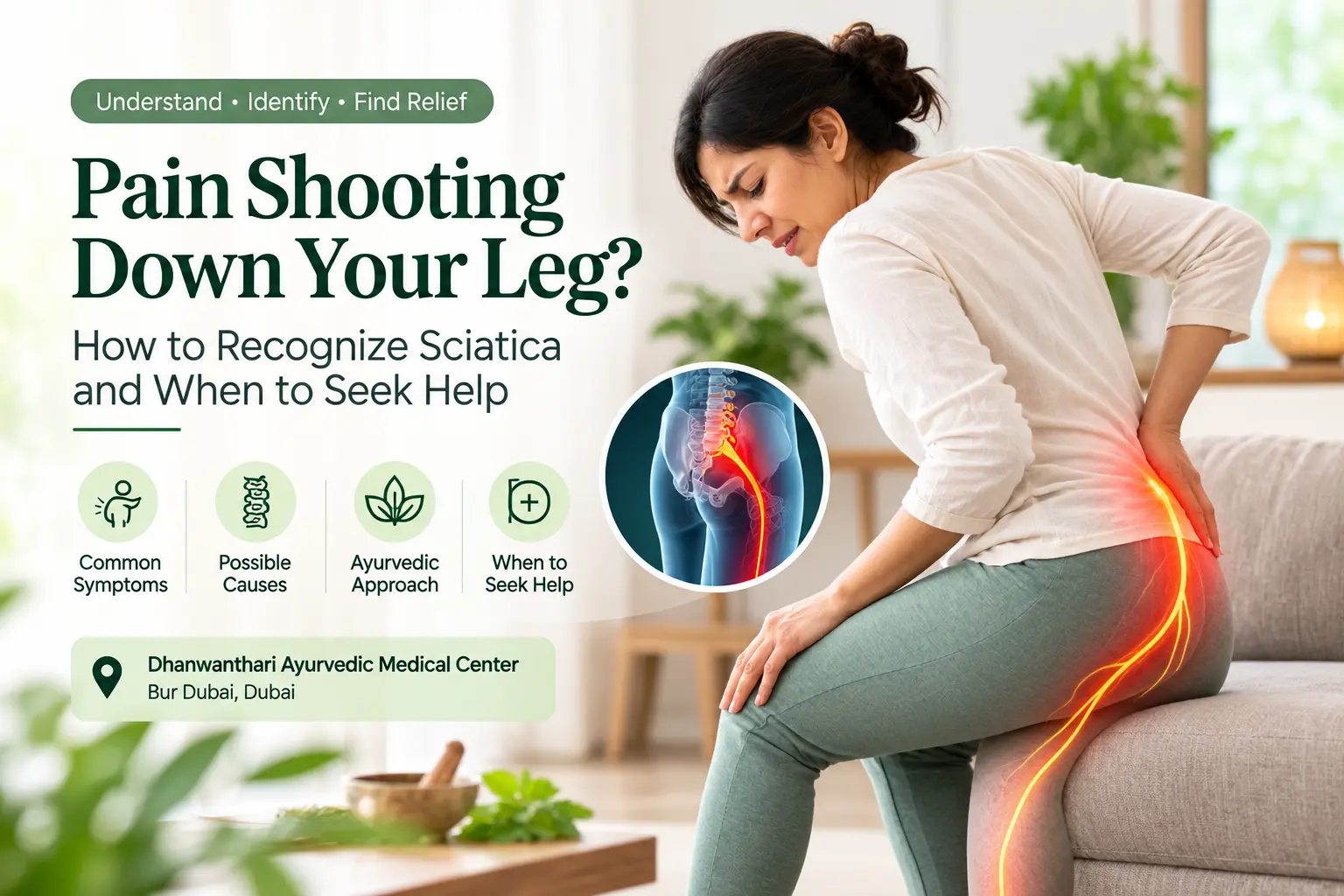
Pain that starts in your lower back or buttock and travels down your leg can be more than ordinary muscle discomfort. If you experience a sharp, burning or shooting sensation, along with tingling, numbness or weakness, it may be related to irritation or compression of the sciatic nerve.
This pattern is commonly associated with sciatica. Understanding what sciatica feels like, what may cause it and when professional assessment is needed can help you take the right next step.
At Dhanwanthari Ayurvedic Medical Center in Bur Dubai, Ayurvedic care for musculoskeletal conditions is individualized according to the person’s symptoms, health history and overall assessment.
🎥 Dr. Jaisam Explains: Pain Shooting Down Your Leg
If you are experiencing pain that travels from your lower back or buttock into your leg, watch this short video by Dr. Jaisam, Consulting Physician at Dhanwanthari Ayurveda.
The video explains why pain travelling down the leg can be associated with sciatica and why understanding the underlying cause is important before choosing a treatment approach.
Instagram Reel: Pain Shooting Down Your Leg? It Could Be Sciatica.
What Is Sciatica?
Sciatica describes symptoms caused by irritation or compression of the sciatic nerve or one of the nerve roots that contribute to it.
The sciatic nerve runs from the lower back through the buttocks and down the leg. Because of its pathway, irritation in the lower spine can produce symptoms much farther down the leg.
According to the NHS, sciatica commonly causes pain affecting the buttock and back of one leg and may also cause tingling, numbness or weakness.
Sciatica is therefore not simply another name for lower-back pain. The characteristic feature is often the radiating pain or altered sensation travelling into the leg.
What Does Sciatica Pain Feel Like?
Sciatica can feel different from person to person.
You may experience:
- Sharp or shooting pain
- Burning sensation
- Tingling or pins and needles
- Numbness
- Weakness in the leg or foot
- Pain travelling from the buttock towards the thigh, calf or foot
- Difficulty sitting or moving comfortably
Some people have significant leg pain with relatively mild back pain. Others may experience both back and leg symptoms.
The symptoms may develop suddenly or gradually and can sometimes become more noticeable with movement, coughing or sneezing.
Why Does Pain Travel From the Back Into the Leg?
The nervous system connects the lower spine with the legs.
When a nerve root in the lower spine becomes irritated or compressed, the resulting pain or altered sensation may follow the pathway of the affected nerve.
This is why the source of the problem may be in the lower back while the person feels the strongest pain in the buttock or leg.
The underlying cause can vary, so persistent radiating pain should not automatically be assumed to have one particular cause.
Common Causes of Sciatica
Several conditions can contribute to sciatic nerve irritation.
| Possible cause | What it means |
|---|---|
| Herniated disc | A disc can irritate or compress a nearby nerve |
| Spinal stenosis | Narrowing around the spinal nerves can create pressure |
| Spondylolisthesis | One vertebra can shift in relation to another |
| Back injury | Injury can affect structures around the spine |
| Degenerative spinal changes | Changes over time may affect the space around nerves |
A proper assessment is important because treatment depends on the underlying problem rather than the symptom alone.
Sciatica or Ordinary Back Pain?
Lower-back pain and sciatica are not always the same.
With ordinary mechanical back pain, discomfort may remain primarily around the lower back.
Sciatica is more typically associated with symptoms extending from the lower back or buttock into the leg.
You should pay attention to:
Where is the pain?
Does it remain around your back, or travel into your buttock and leg?
Is there numbness or tingling?
Altered sensation can indicate involvement of a nerve.
Is there weakness?
Reduced strength in the leg or foot should be medically assessed.
Is it affecting daily activities?
Difficulty walking, sitting, sleeping or working may indicate that professional guidance is needed.
Can Sitting for Long Hours Contribute to Back and Leg Problems?
Many people in Dubai spend long periods sitting at work, commuting or using computers.
Remaining in one position for extended periods can contribute to discomfort and stiffness, particularly when combined with limited movement.
If your work involves prolonged sitting, consider:
- Taking regular movement breaks
- Changing position throughout the day
- Setting up your workstation comfortably
- Avoiding long periods of uninterrupted sitting
- Following an appropriate exercise or movement plan
These habits do not diagnose or treat the underlying cause of sciatica, but maintaining appropriate activity can be part of general back and musculoskeletal care.
When Should You Get Your Symptoms Checked?
Occasional back or leg discomfort may settle, but persistent or worsening symptoms deserve attention.
Consider professional evaluation if:
- Pain continues or repeatedly returns
- Pain is interfering with sleep or daily activities
- You develop persistent numbness or tingling
- Your leg or foot feels weak
- Walking becomes difficult
- Symptoms are getting progressively worse
- Pain follows an injury
A healthcare professional can determine whether your symptoms are consistent with sciatica and whether further investigation is appropriate.
When Is Sciatica an Emergency?
Certain symptoms require urgent medical attention.
Seek emergency care if you develop sciatica affecting both legs, severe or worsening weakness or numbness in both legs, numbness around the genitals or anus, difficulty starting urination, loss of bladder control, or loss of bowel control.
These symptoms can indicate serious nerve compression and should not be managed at home.
Reviewed by Dr. Jaisam
Consulting Physician, Dhanwanthari Ayurveda, Dubai
Dr. Jaisam’s clinical work includes musculoskeletal concerns such as joint pain, back problems and sciatica.
In his educational video, he highlights the importance of paying attention when pain travels down the leg rather than treating it as ordinary muscle pain.
From an Ayurvedic perspective, an individual’s symptoms, constitution, lifestyle, diet, activity and overall health may all be considered when developing a personalized care plan.
The purpose of an Ayurvedic consultation is therefore not simply to identify where the patient feels pain, but to understand the individual pattern before recommending traditional therapies or supportive lifestyle measures.
Sciatica from an Ayurvedic Perspective
In Ayurveda, symptoms resembling sciatica are traditionally associated with Gridhrasi.
Ayurvedic assessment may consider the involvement of Vata, individual constitution (Prakriti), lifestyle, digestion, physical activity and the characteristics of the symptoms.
This traditional Ayurvedic framework is different from a modern neurological diagnosis. If symptoms suggest significant nerve compression or another spinal problem, appropriate medical evaluation remains important.
At Dhanwanthari Ayurveda, traditional Ayurvedic care is personalized rather than applying the same therapy to every person.
How Ayurvedic Care May Support People With Sciatica
Depending on the individual’s assessment, an Ayurvedic practitioner may consider a combination of:
- Traditional external therapies
- Herbal preparations
- Dietary guidance
- Lifestyle recommendations
- Gentle movement guidance
- Rest and activity modifications
- Therapies selected according to the person’s condition
Dhanwanthari’s chronic-care program includes sciatica and lower-back pain among the musculoskeletal conditions addressed through personalized Ayurvedic care.
If you are considering professional Ayurvedic care, you can read about Sciatica Ayurvedic Treatment in Dubai to understand the clinic’s treatment approach.
Traditional Ayurvedic Therapies for Musculoskeletal Care
The specific therapy should be decided after consultation rather than selected based only on an online article.
Depending on individual needs, traditional therapies may include:
Abhyanga
A traditional Ayurvedic oil massage that may be included in selected musculoskeletal care plans.
Kizhi
Warm herbal pouches may be used as part of traditional Ayurvedic therapy. Dhanwanthari’s Podi Kizhi information includes its use for selected concerns such as sciatica and back pain.
Kati Vasthi
A localized traditional therapy involving warm medicated oil applied to the lower-back region.
Swedana
Traditional sudation therapies may be incorporated into certain treatment plans according to individual suitability.
Panchakarma
Selected Panchakarma procedures may be considered when appropriate as part of a broader Ayurvedic treatment plan.
The suitability, duration and combination of therapies should be determined by a qualified Ayurvedic practitioner.
Lifestyle and Joint Care Beyond Sciatica
Sciatica can occur alongside other musculoskeletal concerns, including lower-back pain, stiffness and joint problems.
If you experience more widespread joint or muscle discomfort, Dhanwanthari’s Ayurvedic Joint Pain Treatment in Dubai provides information about its broader chronic-care approach for musculoskeletal conditions.
Daily habits can also influence overall musculoskeletal wellbeing. Regular movement, appropriate physical activity, adequate rest and attention to posture can form part of a healthier routine.
However, lifestyle measures should not delay professional evaluation when neurological symptoms are persistent or worsening.
Choosing the Right Approach for Radiating Leg Pain
Two people can describe their symptoms as “sciatica” while having very different underlying problems.
One person may have symptoms associated with a disc problem. Another may have spinal narrowing or another musculoskeletal or neurological condition.
That is why personalized assessment matters.
At Dhanwanthari Ayurvedic Medical Center, the doctor considers the individual’s symptoms and health history before recommending an Ayurvedic treatment plan.
If you are looking for an Ayurvedic Clinic in Dubai, Dhanwanthari provides doctor-guided consultations and traditional Ayurvedic care in Bur Dubai.
Ayurvedic Care for Sciatica in Bur Dubai
If you regularly experience pain shooting from your lower back or buttock into your leg, do not simply ignore it or assume it is temporary muscle pain.
Understanding the pattern of your symptoms and receiving appropriate professional guidance can help determine the next step.
Dhanwanthari Ayurvedic Medical Center is located at:
Suite #210, 2nd Floor, Al Ain Shopping Centre, Computer Plaza, Near Sharaf DG Metro Station, Exit 1, Bur Dubai, Dubai.
For consultation:
WhatsApp: +971 50 779 6303
Tel: +971 4 220 8421
You can also visit the dedicated Sciatica Ayurvedic Treatment in Dubai page for more information about the clinic’s approach.
FAQs
What does sciatica pain feel like?
Sciatica may cause sharp, burning or shooting pain that travels from the lower back or buttock into the leg. Tingling, numbness and weakness may also occur.
What causes pain to shoot down the leg?
Pain travelling down the leg can occur when the sciatic nerve or one of its nerve roots is irritated or compressed. Possible causes include a herniated disc, spinal stenosis, spondylolisthesis and back injury.
Can Ayurveda help with sciatica?
Ayurvedic care may support the management of sciatica through individualized traditional therapies, lifestyle guidance and dietary recommendations. Treatment should be supervised by a qualified Ayurvedic practitioner and should not replace necessary medical evaluation.
Should I rest completely when I have sciatica?
Complete bed rest is generally not recommended for uncomplicated sciatica. Gentle movement and maintaining normal activities as tolerated may be appropriate for some people, but activity should be adapted to the individual’s symptoms and professional advice.
When should I seek urgent medical care for sciatica?
Seek urgent medical care if you develop numbness around the genitals or anus, new bladder or bowel problems, severe or worsening weakness or numbness in both legs, or sciatica affecting both legs.
Final Takeaway
Pain shooting down your leg can have several causes, and sciatica is one possibility. Radiating pain accompanied by tingling, numbness or weakness deserves attention, particularly when symptoms persist or worsen.
The first step is understanding the symptoms and identifying the possible cause. From there, appropriate medical assessment and individualized care can help determine the next steps.
For people interested in Ayurveda, traditional therapies and lifestyle guidance may be considered as part of a personalized care plan under qualified professional supervision.
If you are experiencing persistent or recurring back, leg or joint discomfort, understanding the broader factors that can affect joint health may also be helpful. Read our Morning Joint Stiffness: What It May Mean and How Ayurveda Supports Joint Health for more information on joint stiffness, mobility and the Ayurvedic approach to joint care.