

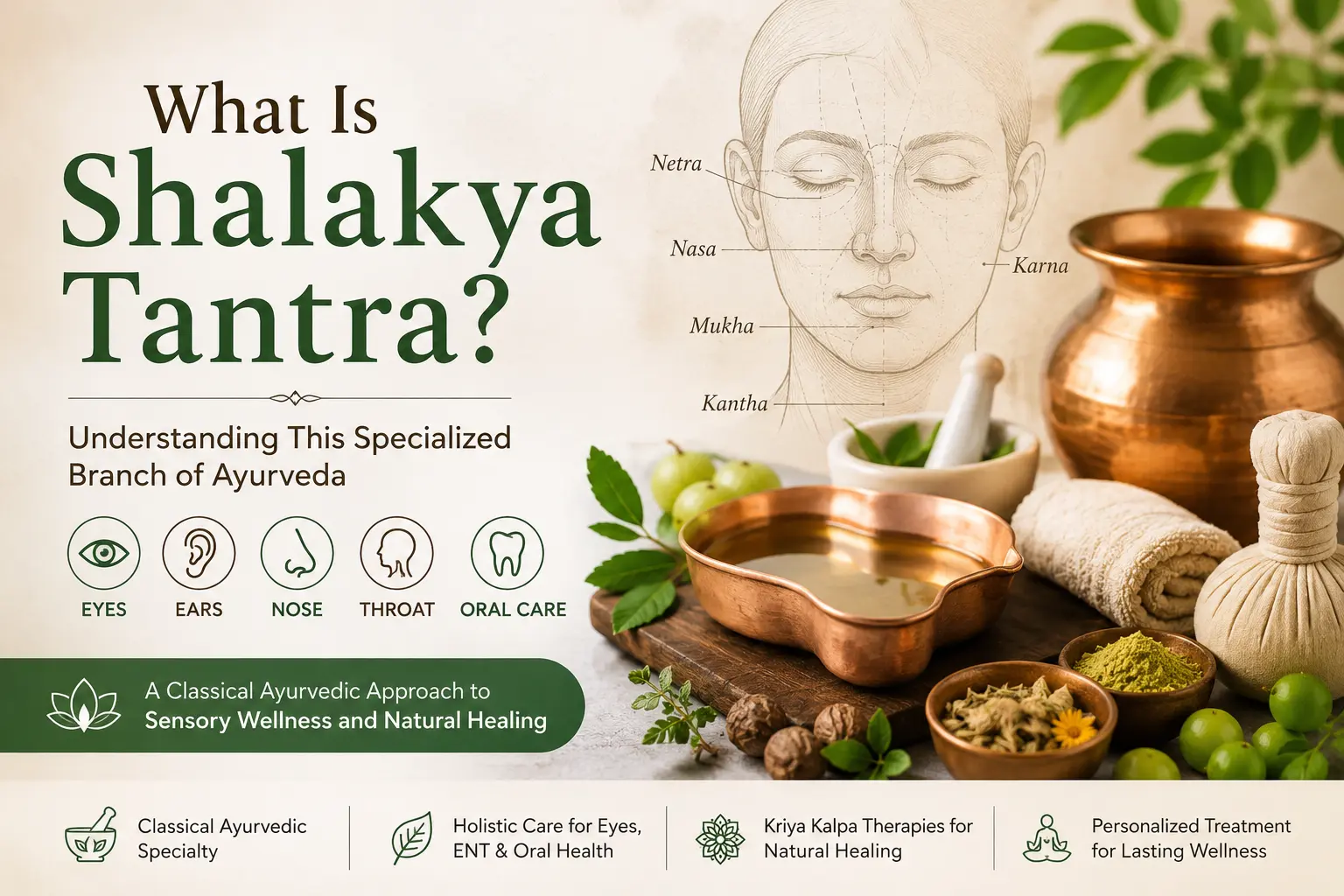
Shalakya Tantra is one of the eight classical branches of Ayurveda and traditionally focuses on the diagnosis, management, and treatment of conditions affecting areas above the neck, including the eyes, ears, nose, throat, head, and oral region.
For people exploring Ayurvedic approaches to eye health, understanding Shalakya Tantra provides useful insight into how Ayurveda traditionally views the eyes and other sensory organs.
In today’s lifestyle, where prolonged screen exposure, environmental factors and demanding work routines can affect everyday comfort, traditional Ayurvedic knowledge continues to attract interest as part of a broader approach to wellness.
At Dhanwanthari Ayurveda in Dubai, Ayurvedic care is based on traditional principles and personalised assessment. The centre provides a range of Ayurvedic treatments and consultations under the guidance of experienced Ayurvedic practitioners.
What Does Shalakya Tantra Mean?
The term Shalakya Tantra refers to a specialized branch of Ayurveda traditionally concerned with diseases and disorders involving the head and sensory organs.
Government Ayurveda sources describe Shalakya Tantra as the branch concerned with the eyes, ears, nose, throat and head, while Ayurveda education and clinical departments also include oral and dental conditions within this specialty.
The branch includes both preventive and therapeutic perspectives, with attention given to maintaining the health and function of important sensory organs.
In simple terms, Shalakya Tantra can be understood as the Ayurvedic specialty that focuses primarily on conditions affecting the eyes, ears, nose, throat, mouth and related structures of the head and neck.
Shalakya Tantra as One of the Eight Branches of Ayurveda
Ayurveda is traditionally described as having eight major branches, collectively known as Ashtanga Ayurveda.
These include:
- Kayachikitsa – Internal medicine
- Shalya Tantra – Surgery
- Shalakya Tantra – Eye, ENT and related head and neck care
- Kaumarabhritya – Paediatrics
- Bhuta Vidya – Traditional approaches concerning mental and psychological disorders
- Agada Tantra – Toxicology
- Rasayana – Rejuvenation and healthy ageing
- Vajikarana – Reproductive health and vitality
The Ministry of AYUSH has described Shalakya as encompassing eye, ENT and dentistry-related specialties within the broader Ayurvedic system.
This classification demonstrates that eye care was not treated as an isolated subject within traditional Ayurveda. Instead, it formed part of a dedicated specialty concerned with important sensory organs and structures of the head.
What Areas Does Shalakya Tantra Cover?
Shalakya Tantra has a broad scope.
Eye Care
The eye is an important area within Shalakya Tantra. Ayurvedic ophthalmology traditionally addresses eye-related conditions and approaches eye wellness through assessment, lifestyle, diet and specialized therapies.
Modern Ayurveda education also has dedicated Shalakya Tantra training in ophthalmology, including the study of eye examination and various ophthalmic conditions.
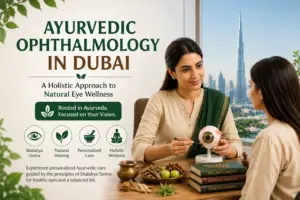
If you are interested specifically in this area, you can learn more about Ayurvedic Ophthalmology in Dubai and how Dhanwanthari approaches traditional eye care.
Ear Care
Shalakya Tantra also encompasses traditional Ayurvedic approaches related to the ears and hearing.
Nose and Sinus Care
The branch includes the nose and related structures, including traditional approaches to certain nasal and sinus-related concerns.
Throat and Head
Conditions involving the throat and other structures of the head are also traditionally included within Shalakya Tantra.
Oral and Dental Care
Traditional Shalakya Tantra also extends to the mouth and teeth. The All India Institute of Ayurveda identifies ophthalmic, ENT and oro-dental care within its Shalakya Tantra department.
Why Are the Eyes Important in Shalakya Tantra?
The eyes have an important place in Ayurveda because vision is one of the primary ways people interact with their surroundings.
The traditional Ayurvedic perspective recognizes the importance of protecting sensory functions and maintaining the health of the structures involved in vision.
This is why Netra Roga, or disorders relating to the eyes, is a dedicated area within Shalakya Tantra education and practice.
Government Ayurveda documentation lists Netra Roga under the Shalakya specialty, corresponding broadly to ophthalmology.
How Does Shalakya Tantra Approach Eye Health?
The Ayurvedic approach to eye health is traditionally individualized.
Instead of assuming that the same approach is appropriate for everyone, an Ayurvedic practitioner may consider:
- Individual constitution or Prakriti
- Lifestyle
- Diet
- Sleep patterns
- Daily routine
- Environmental exposure
- Existing health conditions
- Individual symptoms
- Overall wellbeing
This approach forms part of the broader Ayurvedic principle of considering the individual rather than focusing only on a single symptom.
At Dhanwanthari Ayurveda, consultations are designed around understanding the individual’s health concerns and developing a personalized Ayurvedic approach.
What Are Kriya Kalpa Therapies?
One of the important concepts associated with Ayurvedic ophthalmology within Shalakya Tantra is Kriya Kalpa.
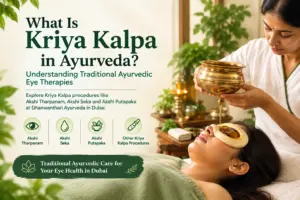
Kriya Kalpa refers to a group of specialized Ayurvedic procedures traditionally used in eye care.
The All India Institute of Ayurveda identifies Kriya Kalpa as an important specialized treatment approach within Shalakya Tantra and describes its use in the management of ophthalmic conditions.
Depending on the individual’s assessment and treatment requirements, traditional eye procedures may include therapies such as:
- Tarpana
- Seka
- Putapaka
- Other practitioner-guided ophthalmic procedures
These therapies should be performed only under the guidance of an appropriately qualified practitioner.
What Is Akshi Tharpanam?
Akshi Tharpanam, commonly referred to as Tarpana, is a traditional Ayurvedic eye-care procedure associated with Kriya Kalpa.
During the procedure, a prescribed preparation is traditionally retained around the closed eyes for a specified period under practitioner supervision.
The exact preparation, duration and suitability depend on the individual’s assessment.
People interested in this traditional therapy can explore Akshi Tharpanam treatment in Dubai at Dhanwanthari Ayurveda.
It is important not to attempt specialised Ayurvedic eye procedures independently, particularly when symptoms have not been professionally assessed.
What Is Akshi Seka?
Akshi Seka is another traditional Ayurvedic eye-care procedure.
It involves the controlled application of a prescribed liquid preparation around or over the closed eyes according to the practitioner’s instructions.
The choice of preparation, duration and method may vary according to the individual’s requirements.
Dhanwanthari Ayurveda includes Akshi Seka among its Ayurvedic treatment offerings. Those interested can learn more about Akshi Seka treatment in Dubai through a professional consultation.
What Is Akshi Putapaka?
Akshi Putapaka is another traditional procedure associated with Ayurvedic ophthalmology and Kriya Kalpa.
Its use and preparation are determined according to traditional Ayurvedic principles and the individual’s assessment.
As with other specialized eye procedures, it should be performed under the supervision of a qualified Ayurvedic practitioner.
Shalakya Tantra and Modern Eye Health
Modern lifestyles have introduced new challenges for eye comfort.
People may spend several hours each day using:
- Computers
- Smartphones
- Tablets
- Televisions
- Digital workstations
Extended screen use may be associated with symptoms such as temporary eye discomfort, dryness, tired eyes and visual fatigue.
This does not mean that every modern eye complaint requires Ayurvedic treatment. Instead, it highlights the importance of maintaining healthy daily habits while seeking appropriate professional care when symptoms persist.
Simple habits can include:
- Taking regular breaks from screens
- Looking away from near-screen tasks periodically
- Maintaining appropriate lighting
- Getting adequate sleep
- Staying hydrated
- Avoiding unnecessary eye rubbing
- Having appropriate professional eye examinations
Is Shalakya Tantra the Same as Modern Ophthalmology?
No.
Shalakya Tantra is a traditional Ayurvedic specialty, while modern ophthalmology is a medical specialty based on contemporary clinical science, diagnostic techniques and treatments.
They should not be presented as identical systems.
For someone interested in Ayurvedic care, traditional therapies may be considered as a complementary approach where appropriate. However, Ayurvedic treatment should not replace necessary medical diagnosis or treatment from a qualified ophthalmologist.
This is particularly important for symptoms that may indicate an urgent eye condition.
When Should You See an Ophthalmologist?
Certain eye symptoms require prompt professional evaluation.
Seek appropriate medical attention if you experience:
- Sudden vision loss
- Major or sudden changes in vision
- Severe eye pain
- Significant eye injury
- Sudden flashes of light
- A sudden increase in floaters
- Severe eye redness accompanied by pain or vision changes
- Unusual or severe eye discharge
- Rapidly worsening symptoms
Ayurvedic treatment should not be used to delay appropriate medical evaluation.
How Can Shalakya Tantra Fit Into a Holistic Approach to Wellness?
One of the distinctive features of Ayurveda is its emphasis on the relationship between lifestyle, diet, daily routines and overall wellbeing.
From this perspective, supporting eye wellness may involve more than a single therapy.
An Ayurvedic practitioner may consider:
Diet
Dietary habits may be reviewed as part of an individual’s overall Ayurvedic assessment.
Daily Routine
Sleep, work patterns, screen exposure and daily activities may all be discussed during consultation.
Lifestyle
Stress, physical activity, rest and environmental factors may be considered when developing an individualized wellness plan.
Traditional Therapies
Where appropriate, specialized Ayurvedic therapies may be recommended based on the practitioner’s assessment.
This holistic perspective does not mean that Ayurveda replaces modern medical care. Instead, it provides a traditional framework for considering health as part of a wider lifestyle.
Shalakya Tantra at Dhanwanthari Ayurveda
Dhanwanthari Ayurveda follows traditional Ayurvedic principles and provides personalized consultations and treatments in Dubai.
The centre’s website highlights experienced Ayurvedic practitioners and a personalized approach to care. Dhanwanthari also lists traditional eye-related therapies including Akshi Seka, Akshi Tharpanam and Akshi Putapaka among its treatment offerings.
For those interested in learning more about Ayurvedic treatments in Dubai, a consultation can help determine which traditional approach, if any, may be appropriate for their individual needs.
Meet the Ayurvedic Practitioners at Dhanwanthari Ayurveda
Dr Sathya K. Pillai – Medical Director & Chief Physician
According to Dhanwanthari Ayurveda’s current doctor profile, Dr Sathya K. Pillai serves as Medical Director & Chief Physician and has more than 35 years of clinical experience in Ayurvedic science and holistic healing. His profile also lists Ayurvedic eye care treatments among his areas of clinical expertise.
His profile states that he combines classical Ayurvedic knowledge with modern functional medicine approaches and focuses on personalised treatment.
Readers can learn more about Dr. Sathya K. Pillai, Ayurvedic Doctor in Dubai, through his detailed practitioner profile..
Why Choose Dhanwanthari Ayurveda?
Dhanwanthari Ayurveda has a long-standing connection with traditional Ayurvedic healthcare. Its parent institution, Dhanwanthari Vaidyasala, was established in 1933 and describes its work as combining traditional Ayurvedic knowledge with research, medicine manufacturing and healthcare innovation.
The Dubai centre emphasises traditional Ayurvedic care, personalised consultations and practitioner-guided therapies.
For people interested in exploring Shalakya Tantra and traditional eye wellness, professional consultation is an important first step.
You can contact Dhanwanthari Ayurveda in Dubai, the Best Ayurvedic Clinic in Dubai, to discuss your concerns and learn whether an Ayurvedic consultation is appropriate for you.
FAQs:
1. What is Shalakya Tantra and what does it treat?
Shalakya Tantra is a specialised branch of Ayurveda that focuses on health conditions affecting the areas above the neck, including the eyes, ears, nose, throat, head, mouth, and teeth. It takes a traditional Ayurvedic approach to assessment and management, using therapies, medicines, diet, and lifestyle recommendations according to an individual’s needs.
2. What is the difference between Shalakya Tantra and modern ENT or ophthalmology?
Shalakya Tantra belongs to the Ayurvedic system of medicine, while ophthalmology and ENT are modern medical specialties. Their areas of focus can overlap, such as eye, ear, nose, and throat concerns, but their diagnostic methods and treatment approaches differ. Ayurvedic care should not replace appropriate medical evaluation, particularly when symptoms are severe, sudden, or potentially serious.
3. What Ayurvedic treatments come under Shalakya Tantra?
Shalakya Tantra includes several traditional therapies depending on the condition being assessed. For eye care, practitioners may consider procedures such as Akshi Tharpanam, Akshi Seka, and Akshi Putapaka, collectively associated with Kriya Kalpa practices. A qualified Ayurvedic practitioner should determine whether a particular therapy suits an individual after consultation.
4. Can Shalakya Tantra help with eye strain and screen-related eye discomfort?
People who experience eye discomfort after prolonged screen use may explore Ayurvedic approaches as part of a broader eye-care routine. A practitioner may assess lifestyle factors and recommend appropriate Ayurvedic therapies or daily-care practices. However, persistent, worsening, or unexplained eye symptoms require evaluation by an appropriate eye-care professional rather than relying only on Ayurvedic treatment.
5. Where can I consult a Shalakya Tantra Ayurvedic practitioner in Dubai?
If you are interested in exploring Shalakya Tantra in Dubai, you can consult a qualified Ayurvedic practitioner for an individual assessment. Dhanwanthari Ayurveda offers Ayurvedic consultations and traditional therapies, including treatments associated with Shalakya Tantra. The practitioner can review your concerns and determine which Ayurvedic approach, if any, may be appropriate for you.
Conclusion
Shalakya Tantra is an important specialised branch of Ayurveda with a broad focus on the eyes, ears, nose, throat, head and oral region.
Its traditional approach emphasises individualised assessment, lifestyle, diet, preventive care and specialised therapies. Within this framework, Ayurvedic ophthalmology and procedures such as Kriya Kalpa have an important place in traditional eye care.
Understanding Shalakya Tantra can help people appreciate the broader Ayurvedic perspective on sensory health while also recognising the importance of modern medical diagnosis and treatment when required.
If you are interested in exploring the traditional Ayurvedic approach to eye wellness, Ayurvedic Ophthalmology in Dubai at Dhanwanthari Ayurveda can be discussed with a qualified Ayurvedic practitioner as part of a personalised consultation.
Book an Ayurvedic consultation with Dhanwanthari Ayurveda to learn more about traditional Ayurvedic approaches to eye and sensory health.
Medical Review
Medically Reviewed By: Dr Sathya K. Pillai
Designation: Medical Director & Chief Physician, Dhanwanthari Ayurveda
Clinical Experience: 35+ years in Ayurvedic science and holistic healing
Dhanwanthari Ayurveda’s current practitioner profile identifies Dr Sathya K. Pillai as Medical Director & Chief Physician and states that he has more than 35 years of clinical experience. His listed areas of expertise include Ayurvedic eye care treatments.
Last Reviewed: [09/02/2026]
Medical Disclaimer
This article provides general information and education only. It does not provide medical advice, diagnosis, or treatment. Qualified practitioners should recommend and administer Ayurvedic therapies after an appropriate consultation.. Ayurvedic care should not replace conventional ophthalmological evaluation or emergency medical treatment. Anyone experiencing sudden vision loss, severe eye pain, significant eye injury or other urgent symptoms should seek appropriate medical attention promptly.