



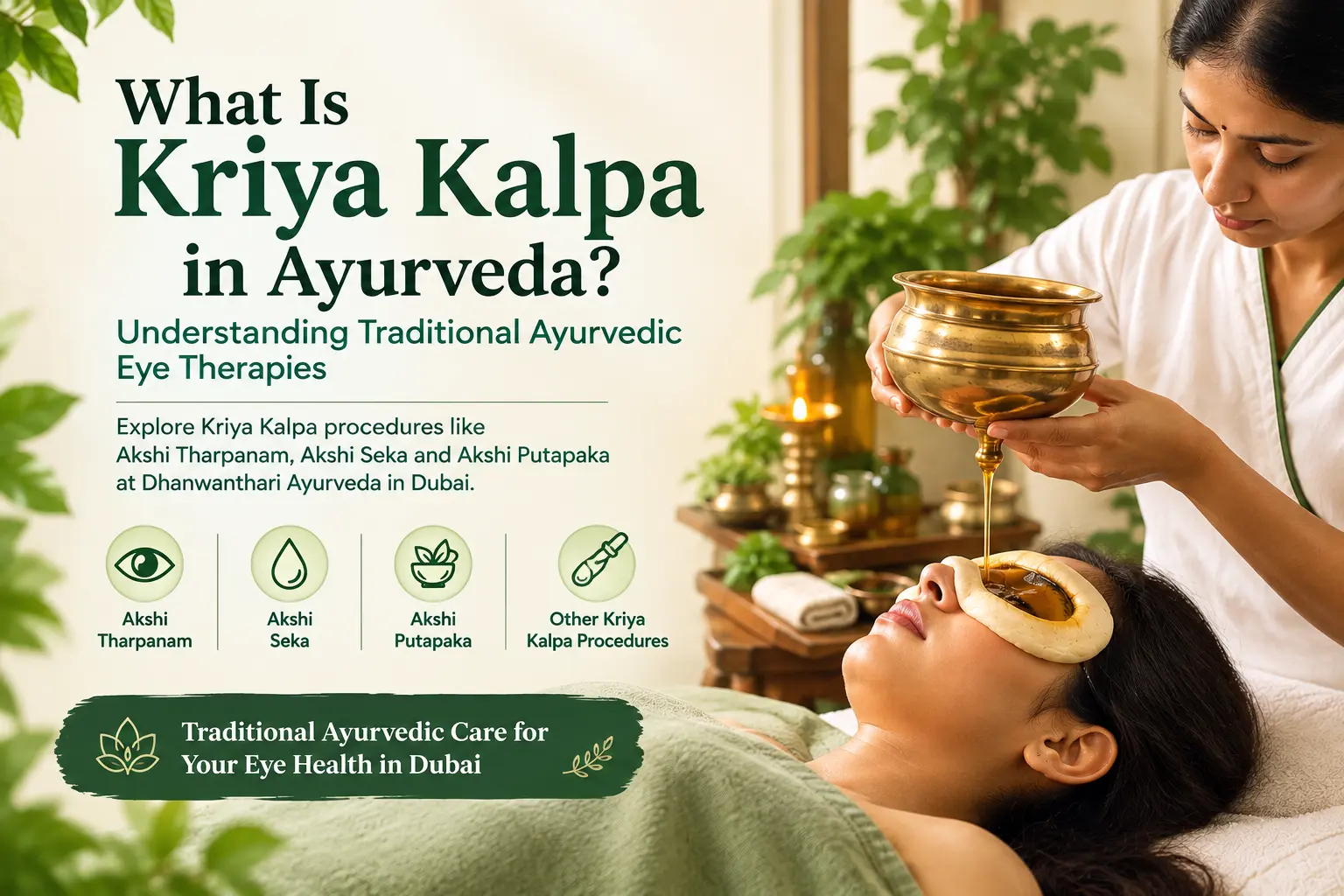
What Is Kriya Kalpa in Ayurveda?
Kriya Kalpa refers to a group of specialized Ayurvedic procedures traditionally associated with Netra Chikitsa (Ayurvedic eye care) within Shalakya Tantra. Classical Ayurvedic sources describe procedures such as Tarpana, Putapaka, Seka, Ashchyotana, and Anjana under Kriya Kalpa. The All India Institute of Ayurveda (AIIA) also identifies these procedures within its Shalakya Tantra department.
For people researching Ayurvedic treatment in Dubai, understanding Kriya Kalpa can provide useful context about how traditional Ayurveda approaches certain aspects of eye care.
Kriya Kalpa is a traditional Ayurvedic approach to eye care that includes procedures such as Tarpana, Seka, Putapaka, Ashchyotana, and Anjana. Practitioners select these procedures according to an individual’s assessment and treatment requirements. Kriya Kalpa should not replace appropriate ophthalmological diagnosis or treatment when a medical eye condition requires conventional care. (AIIA)
What Does Kriya Kalpa Mean?
The term Kriya Kalpa comes from Sanskrit terminology used in Ayurveda. AIIA explains Kriya as a medical treatment procedure and Kalpa as a practical, feasible, suitable, or competent method of treatment.
In Ayurvedic practice, Kriya Kalpa traditionally refers to localized therapeutic procedures associated with eye care.
Rather than treating Kriya Kalpa as one single treatment, it is more accurate to understand it as a group of traditional procedures.
What Are the Main Kriya Kalpa Procedures?
Different Ayurvedic texts describe Kriya Kalpa in slightly different ways. AIIA identifies five procedures described by Acharya Sushruta:
| Kriya Kalpa Procedure | Traditional Description | Area of Focus |
|---|---|---|
| Tarpana | A traditional procedure involving the controlled retention of a prescribed preparation around the eyes | Eye care |
| Putapaka | A classical procedure involving a specially prepared Ayurvedic formulation | Eye care |
| Seka | Controlled application of a prescribed liquid preparation | Eye care |
| Ashchyotana | Traditional instillation of a prescribed preparation into the eye according to Ayurvedic practice | Eye care |
| Anjana | Application of a specific Ayurvedic preparation according to traditional protocol | Eye care |
Some Ayurvedic authorities also describe Pindi and Vidalaka among Kriya Kalpa procedures.
The choice of procedure depends on the practitioner’s assessment rather than a one-size-fits-all approach.
Why Does Kriya Kalpa Have a Place in Shalakya Tantra?
Shalakya Tantra is the Ayurvedic specialty associated with conditions involving the eyes, ears, nose, throat, head and oral region.
Within this specialty, Ayurveda developed specific local procedures for different sensory and head-and-neck concerns. Kriya Kalpa represents the group of procedures traditionally associated with the eyes.
AIIA’s Shalakya Tantra documentation identifies Kriya Kalpa as a dedicated area of clinical practice and records procedures including Tarpana, Putapaka and Ashchyotana.
You can learn more about Shalakya Tantra in Dubai through our related guide on this specialized branch of Ayurveda.
What Is Akshi Tharpanam?
Akshi Tharpanam, commonly called Tarpana, is a traditional Ayurvedic eye procedure within Kriya Kalpa.
During the procedure, the practitioner traditionally creates a suitable boundary around the eyes and retains a prescribed preparation for a specified period under professional supervision.
The preparation, duration and suitability can vary according to the individual’s assessment.
Dhanwanthari Ayurveda currently lists Akshi Tharpanam among its Ayurvedic treatment offerings in Dubai.
If you are researching Akshi Tharpanam treatment in Dubai, a professional consultation should come before the procedure so the practitioner can assess whether it is appropriate for your situation.
What Is Akshi Seka?
Akshi Seka, also known as Netra Seka, is another traditional Kriya Kalpa procedure.
It involves the controlled application of a prescribed liquid preparation around or over the closed eye according to the practitioner’s protocol.
The type of preparation, application method and duration depend on the individual’s assessment.
Dhanwanthari Ayurveda lists Akshi Seka among its current Ayurvedic treatment offerings.
People interested in Akshi Seka treatment in Dubai should consult a qualified Ayurvedic practitioner rather than attempting the procedure independently.
What Is Akshi Putapaka?
Akshi Putapaka represents another classical Kriya Kalpa procedure described in Ayurvedic literature.
AIIA identifies Putapaka as one of the five Kriya Kalpa procedures described by Acharya Sushruta.
The procedure involves a specially prepared Ayurvedic formulation and requires appropriate practitioner knowledge and preparation.
Because the procedure relates to the eye area, people should not attempt Putapaka or other specialized eye procedures without professional guidance.
Dhanwanthari Ayurveda also lists Akshi Putapaka Treatments among its treatment offerings.
What Are Ashchyotana and Anjana?
AIIA identifies Ashchyotana and Anjana alongside Tarpana, Seka and Putapaka as classical Kriya Kalpa procedures.
| Procedure | Traditional Role |
|---|---|
| Ashchyotana | Traditional application of a prescribed preparation to the eye |
| Anjana | Traditional application of a specific Ayurvedic preparation according to established practice |
These procedures require appropriate preparation, assessment and technique. Their traditional use does not mean that everyone with an eye complaint should receive them.
Kriya Kalpa Procedures at a Glance
For readers who want a quick overview:
| Procedure | Part of Kriya Kalpa? | Traditional Ayurvedic Context |
|---|---|---|
| Tarpana | Yes | Specialized eye-care procedure |
| Seka | Yes | Controlled application of a liquid preparation |
| Putapaka | Yes | Classical eye-care procedure |
| Ashchyotana | Yes | Traditional eye application |
| Anjana | Yes | Traditional eye preparation |
| Pindi | Described by some authorities | Local eye-care procedure |
| Vidalaka | Described by some authorities | Local application around the eye |
AIIA notes that different Ayurvedic authorities describe the Kriya Kalpa group somewhat differently, which is why references may vary between sources.
What Happens Before a Kriya Kalpa Procedure?
A responsible Ayurvedic consultation should begin with an assessment rather than immediately selecting a procedure.
The practitioner may discuss:
| Assessment Area | Why It Matters |
|---|---|
| Current symptoms | Helps understand the individual’s concern |
| Medical history | Identifies relevant health conditions |
| Existing eye diagnosis | Helps determine whether conventional eye care is necessary |
| Current medications | Helps identify potential safety considerations |
| Lifestyle | Provides context about daily habits and environmental factors |
| Diet and routine | Forms part of an individualized Ayurvedic assessment |
| Previous treatment | Helps the practitioner understand what care the person has already received |
| Suitability for therapy | Helps determine whether a particular Ayurvedic procedure is appropriate |
This individualized approach is important because not every Kriya Kalpa procedure suits every person.
NCCIH similarly recommends discussing complementary approaches with healthcare providers and choosing practitioners based on appropriate training and experience.
Who May Consider Kriya Kalpa?
People interested in traditional Ayurvedic approaches to eye wellness may discuss Kriya Kalpa with a qualified Ayurvedic practitioner.
A consultation may be relevant for people looking to understand:
- Traditional Ayurvedic eye-care practices
- Kriya Kalpa procedures
- Lifestyle factors associated with eye comfort
- Screen-related lifestyle habits
- Personalized Ayurvedic approaches to wellness
- Whether a particular traditional procedure is appropriate for them
However, interest in Kriya Kalpa does not mean that a person should use it instead of medical eye care.
Can Kriya Kalpa Treat Eye Diseases?
This requires an important distinction.
Kriya Kalpa has a traditional role in Ayurvedic eye care, but that does not establish that every Kriya Kalpa procedure can treat or cure a specific modern eye disease.
Conditions such as glaucoma, cataracts, retinal disease or sudden vision loss require appropriate medical evaluation.
The National Center for Complementary and Integrative Health (NCCIH) advises people not to use unproven approaches as a replacement for conventional treatment of eye conditions.
Therefore, this article does not claim that Kriya Kalpa can cure, reverse or prevent specific eye diseases.
Kriya Kalpa vs Modern Ophthalmology
Kriya Kalpa and modern ophthalmology belong to different healthcare frameworks.
| Kriya Kalpa | Modern Ophthalmology |
|---|---|
| Part of traditional Ayurveda | Medical specialty |
| Associated with Shalakya Tantra | Based on contemporary medical science |
| Uses traditional Ayurvedic procedures | Uses modern examination and diagnostic methods |
| Practitioner assesses the individual according to Ayurvedic principles | Ophthalmologist evaluates eye health using clinical examination and diagnostic technology |
| May form part of an Ayurvedic care plan | Provides medical diagnosis and evidence-based treatment for eye diseases |
| Should not replace necessary medical care | Appropriate for diagnosis and management of eye disease |
These approaches should not be presented as interchangeable.
For people using complementary approaches, NCCIH recommends communicating with healthcare professionals and maintaining coordinated care.
When Should You See an Ophthalmologist?
Some eye symptoms require prompt medical attention rather than a complementary or traditional approach alone.
| Symptom | Recommended Action |
|---|---|
| Sudden vision loss | Seek urgent medical attention |
| Sudden major change in vision | Arrange prompt professional evaluation |
| Severe eye pain | Seek prompt medical assessment |
| Significant eye injury | Seek urgent medical care |
| Sudden flashes of light | Obtain appropriate eye evaluation |
| Sudden increase in floaters | Seek professional assessment |
| Severe redness with pain or vision changes | Seek medical evaluation |
| Severe or unusual eye discharge | Seek appropriate medical care |
| Rapidly worsening symptoms | Do not delay professional evaluation |
NCCIH specifically advises people to follow their eye-care professional’s guidance and not use unproven approaches to replace conventional treatment. (NCCIH)
Can Kriya Kalpa Be Part of a Holistic Wellness Approach?
Yes, people may explore traditional Ayurvedic approaches as part of a broader wellness plan when appropriate.
An Ayurvedic consultation may consider several areas:
- Daily routine
- Diet
- Sleep
- Screen habits
- Environmental factors
- Individual constitution
- Existing health concerns
- Traditional therapies
- General wellbeing
The important point is that a holistic approach should still respect the limits of Ayurvedic treatment and the need for conventional medical care when appropriate.
Kriya Kalpa and Screen-Related Eye Discomfort
Modern work and lifestyle patterns often involve extended periods of screen use.
People may spend several hours using:
- Computers
- Smartphones
- Tablets
- Digital workstations
- Televisions
People experiencing eye discomfort should first consider practical eye-care habits and seek professional assessment when symptoms persist.
A balanced routine may include:
| Healthy Habit | Practical Approach |
|---|---|
| Screen breaks | Look away from the screen regularly during prolonged near work |
| Lighting | Avoid excessive glare and use comfortable workspace lighting |
| Sleep | Maintain a consistent sleep routine |
| Hydration | Drink adequate fluids according to individual needs |
| Eye rubbing | Avoid unnecessary rubbing of the eyes |
| Eye examinations | Follow professional recommendations based on age and risk factors |
| Persistent symptoms | Seek appropriate eye-care evaluation |
These habits complement professional eye care; they do not diagnose or treat an underlying eye disease.
Kriya Kalpa at Dhanwanthari Ayurveda in Dubai
Dhanwanthari Ayurveda currently lists Kriya Kalpas, Akshi Seka, Akshi Tharpanam and Akshi Putapaka among its Ayurvedic treatment offerings in Dubai.
For someone searching for Ayurvedic treatment in Dubai, the appropriate starting point should be a consultation rather than selecting a procedure based only on an online description.
The practitioner can review the individual’s concerns and determine whether a traditional Ayurvedic approach may be appropriate.
This approach also allows the practitioner to identify situations where conventional medical evaluation should take priority.
Meet the Ayurvedic Practitioner
Dr Sathya K. Pillai – Medical Director & Chief Physician
Dhanwanthari Ayurveda’s current practitioner profile identifies Dr Sathya K. Pillai, best Ayurvedic Doctor in Dubai, as Medical Director & Chief Physician and states that he has 35+ years of clinical experience in Ayurvedic science and holistic healing.
Why Choose Dhanwanthari Ayurveda in Dubai?
When researching the best Ayurvedic clinic in Dubai, patients should evaluate more than promotional claims.
Important factors include:
| What to Consider | Why It Matters |
|---|---|
| Qualified practitioners | Supports responsible clinical decision-making |
| Clinical experience | Provides relevant practitioner expertise |
| Individual consultation | Helps avoid one-size-fits-all recommendations |
| Treatment assessment | Helps determine whether a therapy is appropriate |
| Clear communication | Helps patients understand the treatment |
| Safety awareness | Important when therapies involve sensitive areas such as the eyes |
| Coordination with conventional care | Important when medical diagnosis or treatment is required |
FAQs
1. What is Kriya Kalpa in Ayurveda?
Kriya Kalpa refers to a group of traditional Ayurvedic procedures associated with eye care within Shalakya Tantra. AIIA identifies Tarpana, Putapaka, Seka, Ashchyotana and Anjana among the classical Kriya Kalpa procedures. Some Ayurvedic authorities also include Pindi and Vidalaka.
2. What are the main types of Kriya Kalpa?
The main procedures traditionally described under Kriya Kalpa include Tarpana, Seka, Putapaka, Ashchyotana and Anjana. Some sources also describe Pindi and Vidalaka. The exact classification can vary between Ayurvedic authorities.
3. Is Kriya Kalpa suitable for everyone?
No. A qualified Ayurvedic practitioner should assess the individual’s symptoms, health history, existing eye conditions and other relevant factors before recommending a procedure. People with significant or unexplained eye symptoms should also seek appropriate eye-care evaluation.
4. Can Kriya Kalpa replace modern eye treatment?
No. Kriya Kalpa belongs to traditional Ayurvedic practice and should not replace necessary ophthalmological diagnosis or treatment. NCCIH advises people not to use unproven complementary approaches as a substitute for conventional treatment of eye conditions. (NCCIH)
5. Where can I explore Kriya Kalpa treatment in Dubai?
People interested in exploring Kriya Kalpa can consult a qualified Ayurvedic practitioner in Dubai. Dhanwanthari Ayurveda currently lists Kriya Kalpas, Akshi Seka, Akshi Tharpanam and Akshi Putapaka among its Ayurvedic treatment offerings. A consultation can help determine whether a particular traditional procedure is appropriate for the individual.
Conclusion
Kriya Kalpa represents a group of traditional Ayurvedic eye-care procedures within Shalakya Tantra. Classical descriptions include Tarpana, Seka, Putapaka, Ashchyotana and Anjana, while some Ayurvedic authorities also describe Pindi and Vidalaka.
For people exploring Ayurvedic treatment in Dubai, understanding the traditional purpose and limitations of Kriya Kalpa can help them make more informed healthcare decisions.
A qualified practitioner should assess the individual before recommending a procedure, particularly when the therapy involves the eyes. At the same time, people should not delay appropriate ophthalmological care when symptoms indicate a potentially serious eye condition.
If you want to learn more about traditional Ayurvedic eye-care approaches, you can explore Ayurvedic Ophthalmology in Dubai and discuss your concerns with a qualified practitioner at Dhanwanthari Ayurveda.
Medically Reviewed By: Dr Sathya K. Pillai
Designation: Medical Director & Chief Physician, Dhanwanthari Ayurveda
Clinical Experience: 35+ years in Ayurvedic science and holistic healing
Review Date: September 2026
Last Updated: September 2026
Dhanwanthari Ayurveda’s current practitioner profile identifies Dr Sathya K. Pillai as Medical Director & Chief Physician and states that he has more than 35 years of clinical experience.
About the Author
This article was prepared by the Dhanwanthari Ayurveda content team to provide educational information about Kriya Kalpa and its place within traditional Ayurvedic eye care.
The article draws on information from recognized Ayurvedic institutional sources and public health guidance and distinguishes traditional Ayurvedic practices from modern ophthalmological diagnosis and treatment.
Medical Disclaimer
This article provides general information and education only. It does not provide medical advice, diagnosis, or treatment. Qualified practitioners should recommend and administer Ayurvedic therapies after an appropriate consultation.
Ayurvedic care should not replace necessary ophthalmological evaluation or emergency medical treatment. Anyone experiencing sudden vision loss, severe eye pain, significant eye injury, sudden major vision changes, or other urgent symptoms should seek appropriate medical attention promptly.